
If you spend long enough on the Costa del Sol, you start to notice a pattern.
People arrive saying things like, “We’re just here for a week,” or “We’re going to try one year and see how it goes.” Fast-forward a couple of summers and they’re arguing about which chiringuito does the best espeto, complaining about traffic in August like locals, and casually dropping “our lawyer” and “our gestor” into conversation.
So what is it about this strip of coastline – especially the Mijas and Marbella area – that gets under people’s skin?
It’s not just “sun and beach.” It’s the way the whole place is set up for living.

You wake up, pull back the curtains, and it’s blue again. Not occasionally, not “if you’re lucky” – just… again. The mountains sit behind you, the sea in front, and most days you can have coffee outside without even thinking about a jacket. The stretch of coast around Marbella has a particular microclimate: sheltered by the Sierra Blanca, open to the Mediterranean, it stays surprisingly mild in winter and not as punishing as you’d expect in summer. Average temperatures hover around 18–19ºC and the region clocks up roughly 300+ days of sunshine a year.
Mijas plugs into the same system. Down on Mijas Costa, people are out walking dogs on the paseo in T-shirts while friends back home are scraping frost off windscreens. Up in Mijas Pueblo, the air is a little cooler and cleaner, with whitewashed streets and sea views from pretty much everywhere. You realise you’ve gone from “checking the weather” to just assuming you’ll be able to sit outside.
That alone changes how you live. You don’t plan life around escaping the weather; you plan it around enjoying it.

Very quickly, food becomes part of the rhythm.
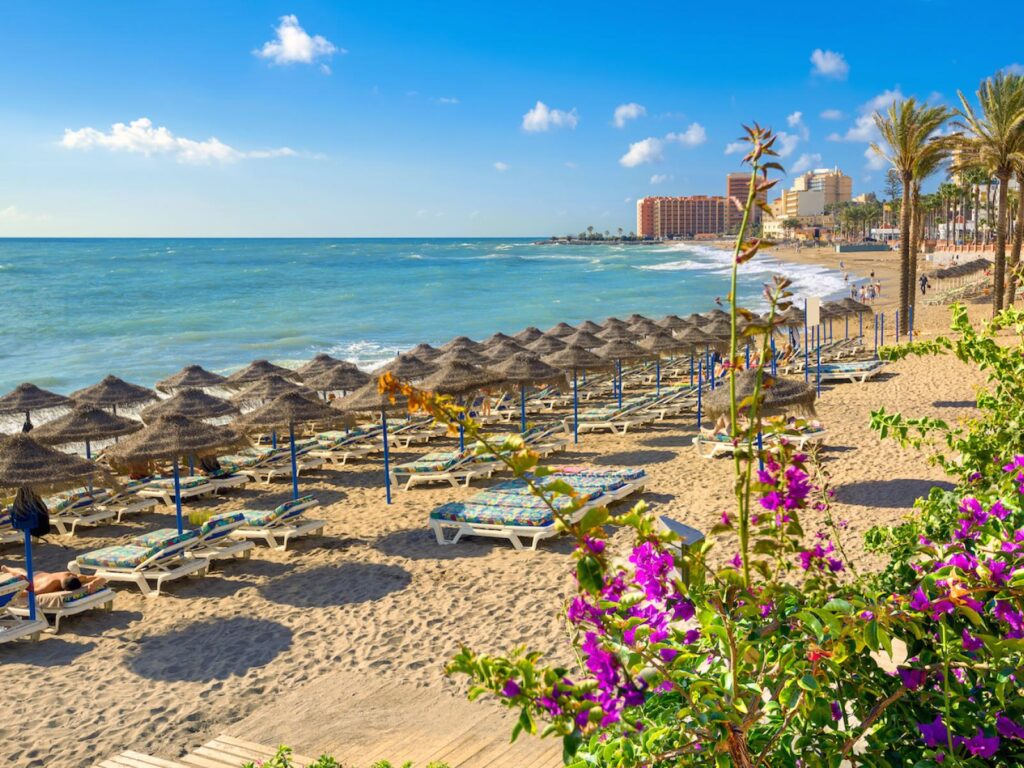
Somewhere between Málaga and Marbella you have your first proper espeto – fresh sardines skewered and grilled over an open fire on the beach – and you understand why locals get emotional about it. It’s smoky and salty and so simple that if you tried to recreate it at home, it wouldn’t taste the same. The whole ritual of chiringuitos (beach bars) is like that: plastic chairs in the sand, cold beer, kids running back and forth from the water, “just a quick lunch” that mysteriously turns into a three-hour hangout.
Inside the towns you get the classic Andalusian mix: tapas bars with fried fish and boquerones, tiny places doing croquetas and tortilla that taste like somebody’s grandmother still runs the kitchen, ice-cold gazpacho in summer. But because places like Mijas and Marbella have such a big international crowd, you’re never stuck with just one thing. One street might have a Scandinavian café, an Argentine steakhouse, a Japanese place and a late-night churros bar all within a few metres.
You don’t have to pick sides: you can be the person who orders paella on Sunday, ramen on Tuesday and a full English on Saturday morning without anyone blinking.
Then there’s the way people use the day.
On the Costa del Sol, life is quietly built around being outside. You see people walking or running along the promenade before work, having a quick coffee on a terrace instead of grabbing one in a car, doing calls from balconies. Kids play football in plazas at hours that would horrify northern European grandparents. Dinner at 10pm in summer is completely normal.
And it isn’t just tourists doing that. Marbella has over 150,000 registered residents and a huge percentage of them are foreigners. Mijas, Fuengirola, Benalmádena – all along the coast the population has been growing, not shrinking, and a big chunk of that growth is international.
That’s why the place doesn’t feel like a resort that shuts down half the year. Schools are full, gyms are busy, supermarkets actually have locals in them. There’s a real city anchor in Málaga – with museums, concerts, a proper food scene and a big tech/remote-work community – but you can live in Mijas or Marbella and dip in and out of that when you want.
The thing that really surprises people, though, is how easy it is to feel like you belong.
In a lot of places, being foreign carries a kind of permanent “otherness.” Here, especially between Mijas and Marbella, everyone is from somewhere. Roughly a third of Marbella’s residents are foreign, and in some neighbourhoods it feels like even more.
That changes the social rules. Nobody expects your Spanish to be perfect in week one. Waiters switch languages without drama. Your neighbour might be Dutch on one side and Spanish on the other, with an English kids’ playgroup in the park down the road. Conversations start with “Where are you from?” but they don’t get stuck there. Before long you know who’s good for tax advice, who’s got a cousin in construction, and which WhatsApp group you need to be in to find a decent plumber.
There’s also a long history of openness along this coast. Torremolinos, a short hop from Mijas, has been one of Spain’s best-known LGBTQ+ destinations for decades and is still considered the “gay capital” of the Costa del Sol, with a big pride celebration and a whole strip of gay-friendly venues. That attitude of “you do you” largely permeates the wider coast. Spain’s legal protections for LGBTQ+ people sit among the strongest in Europe, and here you feel that: same-sex couples walking hand-in-hand, rainbow flags on bars, mixed groups everywhere.
For people coming from more conservative or more closed environments, that combination of sun, safety and social acceptance is a huge part of why it feels so different.
You arrive for a break. You notice you haven’t checked the forecast in days. You start to recognise the guy in the café downstairs. You discover your favourite stretch of beach and the exact bar stool where the evening light hits best. You catch yourself planning “next winter” instead of “next holiday.”
The Costa del Sol – especially around Mijas and Marbella – works on people slowly. It doesn’t hit you over the head. It just keeps offering up good days: warm mornings, easy food, friendly faces, a sense that your life can be a little lighter and a lot more outside.
And once you’ve had a taste of that, it’s very easy to see why so many people come “just to try it”… and never quite manage to leave.
WhatsApp us