
Why People Move to the Costa del Sol—and Stay
- Alex Dolipschi
- November 30, 2025
- 1:58 pm
Living around Mijas and Marbella
If you spend long enough on the Costa del Sol, you start to notice a pattern.
People arrive saying things like, “We’re just here for a week,” or “We’re going to try one year and see how it goes.” Fast-forward a couple of summers and they’re arguing about which chiringuito does the best espeto, complaining about traffic in August like locals, and casually dropping “our lawyer” and “our gestor” into conversation.
So what is it about this strip of coastline—especially the Mijas and Marbella area—that gets under people’s skin?
It’s not just sun and beach. It’s the way the whole place is set up for living.

The climate changes everyday life
You wake up, pull back the curtains, and it’s blue again. The mountains sit behind you, the sea in front, and on many days you can have coffee outside without thinking about a heavy winter coat. The stretch around Marbella is sheltered by the Sierra Blanca and open to the Mediterranean, which helps create a mild coastal climate.
AEMET’s 1981–2010 climate normals for Málaga Airport record an annual mean temperature of 18.5°C and about 2,905 hours of sunshine. Conditions vary along the coast and with elevation.
Mijas shares the same wider coastal climate. Down on Mijas Costa, people walk the paseo through much of the year. Up in Mijas Pueblo, the higher elevation can feel cooler, with whitewashed streets and broad sea views.
That changes how you live. You spend less time planning around the weather and more time enjoying the outdoors.

Food becomes part of the rhythm
Somewhere between Málaga and Marbella you have your first proper espeto—fresh sardines skewered and grilled over an open fire on the beach—and understand why locals get emotional about it. It’s smoky, salty and so connected to the setting that recreating it at home never feels quite the same. The whole ritual of chiringuitos is like that: simple tables near the sand, cold drinks, children moving between lunch and the water, and a “quick meal” that becomes an afternoon.
Inside the towns you find the classic Andalusian mix: tapas bars, fried fish, boquerones, croquetas, tortilla and cold gazpacho in summer. Because places such as Mijas and Marbella also have large international communities, the choice extends far beyond local food.
You do not have to pick sides: paella on Sunday, ramen on Tuesday and a full English breakfast at the weekend can all fit naturally into life here.
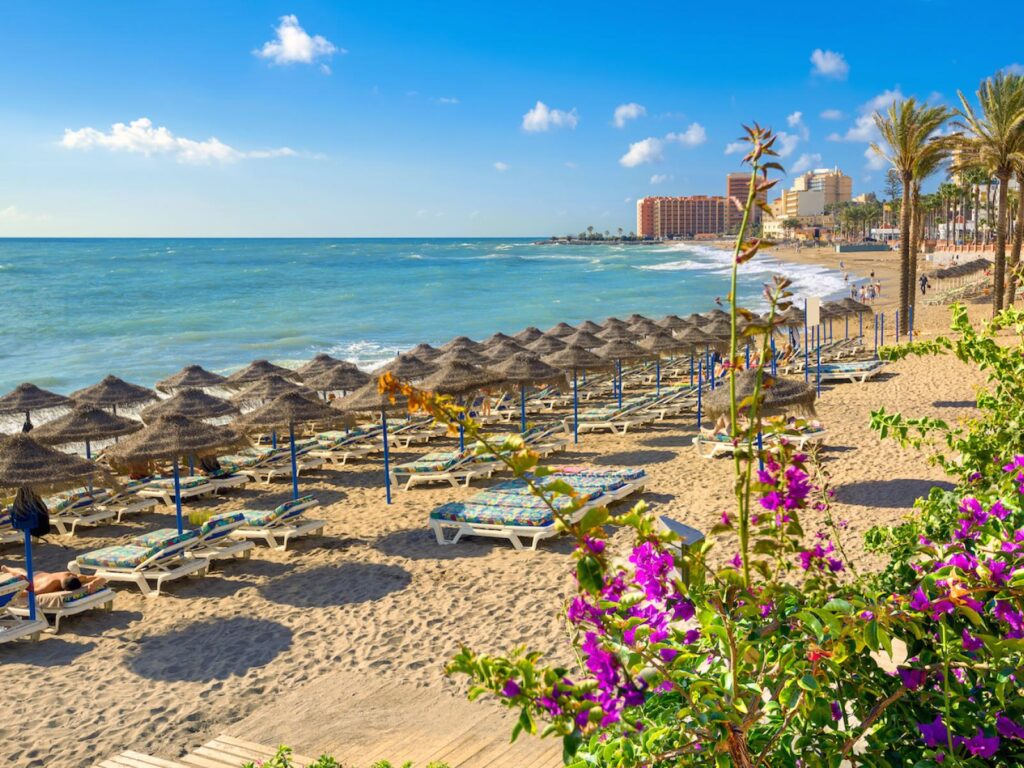
Life happens outdoors
On the Costa del Sol, daily life is quietly built around being outside. People walk or run along the promenade before work, meet for coffee on terraces and take calls from balconies. Children play football in plazas late into summer evenings, and dinner at 10pm is completely normal.
It is not only tourists living this way. Marbella’s municipal register counted 165,871 residents on 1 January 2024. Mijas, Fuengirola and Benalmádena are also lived-in towns with schools, gyms, shops and services throughout the year.
Málaga provides a larger city anchor with museums, concerts, restaurants and transport connections, while living in Mijas or Marbella lets you dip in and out of city life when you want.
An international community makes belonging easier
One of the biggest surprises is how quickly newcomers can feel at home. Between Mijas and Marbella, almost everyone seems to be from somewhere else. Around one-third of Marbella’s registered residents were foreign nationals in 2024 municipal data.
That changes the social rules. Nobody expects perfect Spanish in week one. Neighbours, schools and local businesses are used to multilingual communities, and useful local knowledge often travels quickly through personal networks.
The coast also has a long tradition of openness. Torremolinos has been a well-known LGBTQ+ destination for decades, and that relaxed “you do you” attitude can be felt across much of the wider Costa del Sol. For many newcomers, the combination of climate, community and social acceptance is an important part of the appeal.
Why people decide to stay
You arrive for a break. You notice you have not checked the forecast in days. You start to recognise the person in the café downstairs. You discover your favourite stretch of beach and catch yourself planning “next winter” instead of “next holiday.”
The Costa del Sol—especially around Mijas and Marbella—works on people slowly. It keeps offering good days: mild mornings, easy food, friendly faces and a life that can feel lighter and more outdoors.
Once you have had a taste of that, it is easy to understand why so many people come “just to try it” and decide to stay. For owners considering longer off-season stays, our Costa del Sol winter-lets guide explains the practical trade-offs.
If you already own a holiday home here, see how our Costa del Sol property management service handles the day-to-day work.
Facebook
Linkedin
X
Pinterest
WhatsApp